
Private Credit for Energy and Decommissioning Projects: A Strategic Financing Solution for Infrastructure Transitions

Traditional banks have pulled back from funding large energy projects, leaving a significant gap in available capital. Private credit has emerged as a major financing source for energy infrastructure and decommissioning projects, with firms like Blackstone, Brookfield, and Nuveen leading investments worth billions of dollars.
This shift affects how renewable energy facilities, natural gas projects, and end-of-life decommissioning get funded.
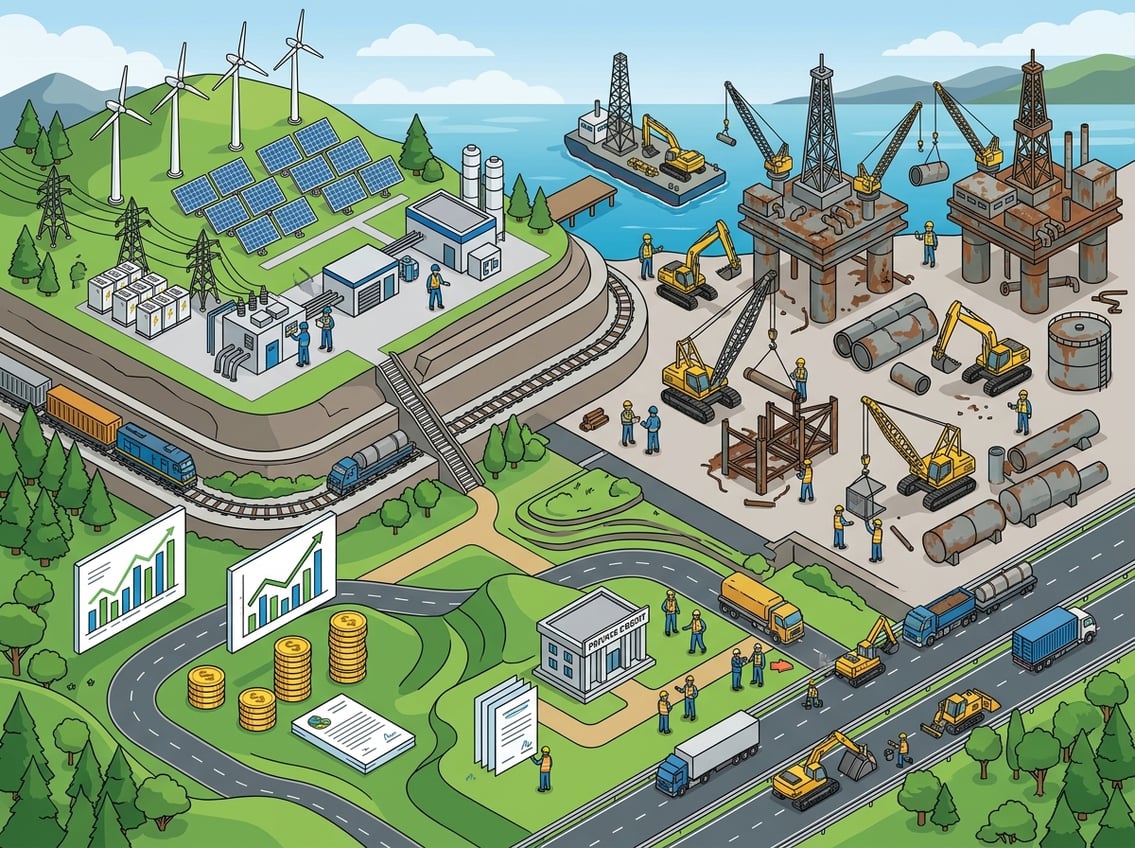
You really need to understand how private credit works in the energy sector, whether you're a project developer, investor, or landowner. Private credit providers finance everything from new solar installations to the expensive process of removing and recycling old wind turbines.
These deals usually move faster than traditional bank loans. They can handle complex project structures that banks often won't touch.
The private credit market for energy projects has grown quickly because it solves real funding challenges. Banks often avoid these deals due to climate risks or the capital-intensive nature of infrastructure.
Private credit fills this gap by offering flexible financing for both clean energy transitions and fossil fuel projects. It also covers the decommissioning phase that every energy facility eventually faces.
Key Takeaways
- Private credit firms now provide major funding for energy projects as traditional banks retreat from capital-intensive infrastructure deals.
- You can use private credit to finance renewable energy development, fossil fuel projects, and end-of-life decommissioning costs.
- Private credit offers faster approval and more flexible terms than traditional bank financing for complex energy infrastructure.
Market Landscape and Key Drivers
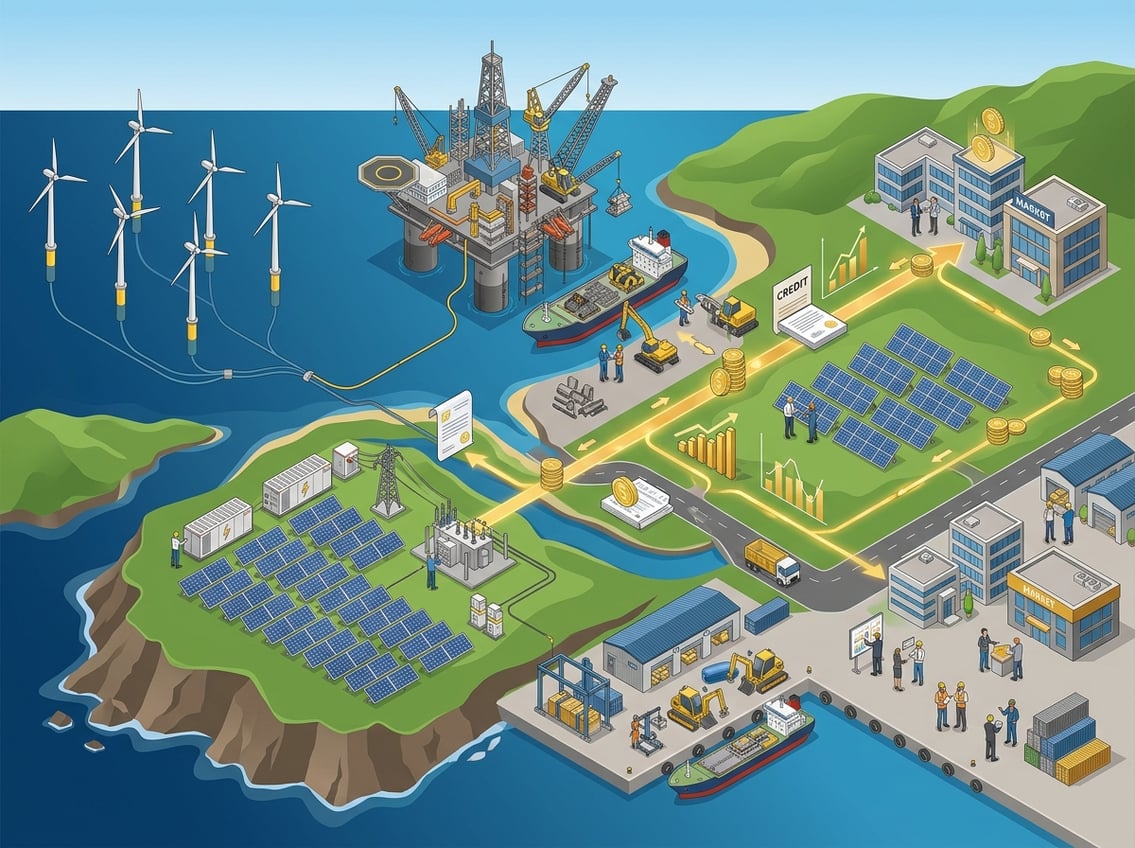
Private credit has expanded rapidly into energy and infrastructure financing. Traditional banks are reducing their lending in these sectors.
Institutional investors now provide capital for a wide range of projects. These range from renewable energy installations to aging infrastructure that needs careful decommissioning.
Current Trends in Energy Financing
Traditional banks have pulled back from energy sector lending due to regulatory constraints and environmental considerations. This has created a funding gap that private credit providers are stepping in to fill.
Non-bank institutional investors have become the main source of capital for many energy projects. They offer longer commitment periods that work with the timelines typical in energy development and decommissioning work.
Key financing areas include:
- Clean energy infrastructure development
- Grid modernization projects
- Transportation system upgrades
- Digital infrastructure buildouts
Private credit funds can structure deals for complex or non-standard projects that don't fit traditional lending criteria. This flexibility lets them finance emerging technologies and unconventional assets that banks usually avoid.
Demand Drivers for Alternative Lending
You need capital sources that understand the unique risks and timelines of energy projects. Private credit lenders specialize in these sectors and can move faster than traditional institutions.
The global push for energy transition has created massive capital requirements. Infrastructure debt in the mid-market segment offers stable returns while funding essential projects.
Asset-backed finance has become a core component of meeting these growing funding needs. Decommissioning projects require specialized financing approaches.
These initiatives often involve environmental remediation, equipment removal, and site restoration that can take years. Private lenders can structure patient capital solutions that fit these longer timeframes.
Market Segments in Need of Private Credit
Four main asset classes present the strongest opportunities for private credit in energy sectors.
Infrastructure and project finance represents the largest segment. You can access funding for new renewable energy installations, transmission lines, and storage facilities.
These projects generate predictable cash flows that work well with private credit structures. Asset-backed finance supports equipment purchases and operational needs, like financing for solar panels, wind turbines, and decommissioning equipment.
Higher-risk commercial real estate in the energy sector includes facilities like refineries and power plants transitioning to new uses. Certain residential mortgages tied to energy-efficient housing projects also attract private credit interest, though that's a smaller segment.
Structuring Private Credit Solutions
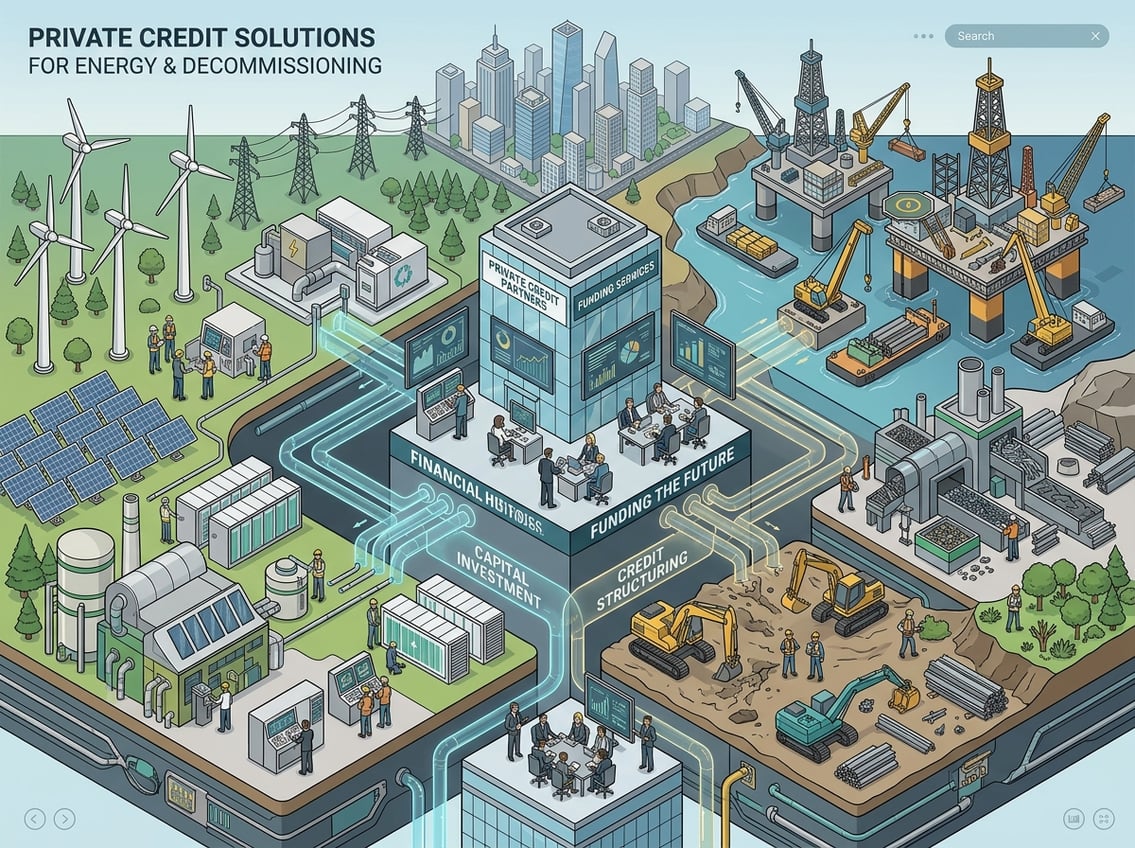
Private credit structures for energy and decommissioning projects blend standard debt instruments with customized terms. Lenders design facilities that balance security needs with operational flexibility.
Covenant packages often reflect technical and environmental milestones for each project phase.
Debt Instruments and Facilities
Private credit providers structure facilities as senior secured debt, unitranche loans, or mezzanine financing depending on your project's needs. Senior secured debt offers the lowest cost but requires first-priority liens on assets and cash flows.
Unitranche structures combine senior and subordinated debt into a single facility. This approach simplifies documentation and speeds up execution for mid-sized projects.
Term loans remain the most common instrument for operational energy assets with predictable cash flows. You get the full commitment upfront and repay according to an amortization schedule that matches your revenue projections.
Delayed draw facilities work better for construction or decommissioning projects. You draw capital in stages tied to completion milestones.
Revolving credit facilities provide short-term liquidity for working capital needs during operational phases. Some lenders offer hybrid structures that include both term and revolver components in one agreement.
Tailoring Risk and Return Profiles
Your pricing reflects the specific risk factors of energy transition and decommissioning work. Lenders charge higher spreads for construction-phase lending than for operational assets, since completion risk creates uncertainty.
Interest rates typically range from SOFR plus 400 to 800 basis points, depending on asset quality and sponsor creditworthiness. Payment-in-kind (PIK) options let you defer cash interest during ramp-up periods when project revenues haven't hit full capacity.
You'll pay a higher effective rate on PIK debt, but it preserves liquidity when you need it most. Equity kickers give lenders upside participation through warrants or revenue shares.
This structure reduces your cash interest burden but dilutes returns if the project performs well. Success fees tied to decommissioning completion or production targets align lender and borrower incentives around operational milestones.
Covenant and Security Considerations
Financial covenants focus on metrics relevant to energy projects, not just corporate ratios. You'll see debt service coverage ratio (DSCR) requirements of 1.2x to 1.5x, loan-to-value (LTV) tests, and reserve account minimums for debt service and maintenance.
Operational covenants address technical performance thresholds, environmental compliance deadlines, and decommissioning fund adequacy. Lenders require you to maintain certain capacity factors for generation assets or hit regulatory milestones for decommissioning.
Security packages usually include:
- First-priority liens on all project assets and equipment
- Pledges of equity interests in project companies
- Assignment of material contracts like power purchase agreements and service agreements
- Control accounts for cash management and waterfall distributions
Lenders often ask for completion guarantees from sponsors during construction and parent guarantees for decommissioning obligations. You might negotiate release mechanisms tied to hitting operational benchmarks or maintaining certain coverage ratios for a set period.
Assessment of Borrower Eligibility
Private credit lenders evaluate energy and decommissioning projects using tough standards. They look at project maturity, financial health, and operational risk.
Your ability to secure financing depends on meeting benchmarks across project stage, creditworthiness, and operational capabilities.
Project Stage and Asset Type
Lenders usually favor projects that have moved past the conceptual phase and show clear revenue pathways. Operating energy assets with established production records get better terms than development-stage projects.
For renewable energy ventures, you need to show proven technology, not just an idea. Decommissioning projects have different requirements.
You must provide detailed scopes of work, regulatory approvals, and site assessments. Lenders want to see that your project addresses specific assets—oil wells, power plants, offshore platforms—with defined timelines.
Asset types that attract private credit:
- Operating renewable energy facilities (solar, wind, hydroelectric)
- Infrastructure projects with contracted revenue
- Traditional energy assets needing capital improvements
- Decommissioning projects backed by regulatory requirements or reserve funds
Development-stage projects require additional guarantees or partnerships with experienced operators. Your project's location matters, too—lenders prefer jurisdictions with stable regulatory frameworks and transparent permitting.
Creditworthiness Criteria
Your financial statements need to show cash flow stability and debt service coverage ratios above 1.2x. Lenders check your balance sheet strength, existing debt, and access to more capital.
For project finance structures, the project itself must generate enough revenue to cover debt payments. You need to show committed offtake agreements or power purchase agreements that extend beyond the loan term.
Revenue certainty through long-term contracts really strengthens your position. Your management team's experience in similar projects is a big factor in the credit assessment.
Key financial metrics lenders evaluate:
- Debt service coverage ratio (DSCR)
- Loan-to-value ratio
- Historical financial performance
- Projected cash flows with stress testing
Due Diligence Priorities
Lenders conduct extensive technical reviews of your engineering plans, equipment specs, and construction timelines. You need to provide environmental impact assessments, permits, and regulatory compliance documents.
Your operational plans should detail maintenance schedules, insurance coverage, and contingency measures. For decommissioning projects, you need detailed cost estimates from qualified engineering firms and proof of regulatory obligations.
Lenders check that your budget includes enough contingency reserves for unexpected problems. They also assess your relationships with contractors, regulators, and other stakeholders who can influence project execution.
Application in the Energy Sector
Private credit is now a financing solution across multiple energy categories, from renewables to aging fossil fuel infrastructure. Lenders are stepping into the gaps left by traditional banks and adapting their structures to match the risk profiles of different energy assets.
Renewables and Clean Energy Projects
Private credit funds are actively financing solar, wind, and battery storage projects that need substantial upfront capital. These investments usually offer predictable cash flows through power purchase agreements, making them attractive to direct lenders seeking stable returns.
Mid-sized renewable projects often struggle to access traditional bank financing because of their scale or technology type. Private lenders step in to fund specialized applications like industrial solar installations, next-generation energy storage, and grid upgrades.
You can secure financing for projects that fall outside the conventional renewable categories favored by institutional investors. The financing terms usually range from 5 to 15 years, matching the operational timeline of renewable assets.
Interest rates vary based on technology maturity and revenue certainty. Projects with established off-take agreements generally get better terms than merchant facilities selling power at market rates.
Oil and Gas Asset Needs
Traditional banks have pulled back from fossil fuel projects. They’re wary of climate risk and feel the heat from regulators.
Private credit managers have stepped in to fill the funding gap. They’re focusing on production facilities, midstream infrastructure, and operational upgrades.
You can tap private credit for acquiring producing assets, upgrading equipment, or reserve-based lending. The financing structure often uses floating rates tied to commodity prices or production volumes.
Lenders usually want detailed reserve reports. They might use borrowing base calculations that adjust your available credit based on proven reserves.
Decommissioning obligations are becoming a bigger part of oil and gas financing. When operators don’t have enough reserves or face near-term closures, private lenders provide capital for shutdowns, well plugging, and site restoration.
Hybrid and Transitional Energy Models
Energy companies juggling both conventional and renewable assets need flexible capital. Traditional lenders rarely offer that kind of flexibility.
Private credit steps in for businesses during these transition periods. You might use it to fund natural gas facilities that support renewables or to finance infrastructure serving multiple energy types.
Data centers, for example, want reliable baseload power alongside renewables. That’s become a key growth area.
Lenders structure deals to account for revenue streams from each energy source, since each one comes with its own risk profile.
Hybrid arrangements often include milestone-based funding releases tied to project phases or performance metrics. Sometimes, your financing terms will have sustainability-linked features that tweak rates based on emissions targets or renewable additions.
Financing Energy Decommissioning
Decommissioning energy assets takes serious capital planning. Industry estimates put global costs at $8 trillion over the next few decades.
Right now, only about $0.5 trillion is pre-funded. That leaves $7.5 trillion riding on operator creditworthiness when it’s actually time to decommission.
Cost Structures and Forecasting
When planning decommissioning, you need to consider a bunch of cost components. Site assessment, hazardous material removal, equipment dismantling, waste disposal, and land restoration all add up.
Labor costs eat up 40-50% of total project expenses. That’s a big chunk.
Forecasting models need to account for inflation over the asset’s life, which could be 20-40 years. Don’t forget about tech changes—they might raise or lower future costs.
Private credit lenders look closely at these projections. Underestimating costs by even 15-20% can put the whole project at risk.
Nuclear facilities are the priciest to decommission, often topping $1 billion per plant. Oil and gas platforms, wind farms, and coal plants cost less but still need dedicated funding mechanisms.
Stakeholder and Regulatory Considerations
Navigating regulatory frameworks is tricky—they vary by jurisdiction and asset type. Most regulators want proof of financial capability before you get an operational license.
Your funding structure has to show that resources will be there, no matter what happens to your company’s finances down the road.
Private credit providers often work with government agencies, development finance institutions, and equity partners in blended finance arrangements. This spreads risk across multiple parties.
Regulators might require trust funds or surety bonds, which shapes your financing options.
Transparency rules mean you’ll need to report regularly on fund adequacy and investment performance. Stakeholders expect clear updates about any shortfalls or overruns.
Risk Mitigation Techniques
You’ve got a few ways to protect against funding gaps in decommissioning. Escrow accounts set aside reserves separate from your main capital.
Insurance products designed for decommissioning risks can shift some liability to third parties.
Your risk assessment should include operator solvency, especially if assets change hands during the energy transition. Private credit structures often have covenants requiring minimum funding as assets age.
Other strategies worth considering:
- Incremental funding schedules that ramp up as assets near retirement
- Third-party guarantees from financially solid backers
- Hybrid debt instruments with decommissioning-specific terms
- Diversification across projects and regions
Market swings can hit investment returns on pre-funded amounts. It’s wise to keep return assumptions conservative in your planning.
Environmental, Social, and Governance Impact
ESG factors shape the risk and viability of energy and decommissioning projects in private credit. Lenders need to check sustainability metrics, ensure regulatory compliance, and look at community relationships before financing.
Sustainability Metrics
Tracking the right ESG indicators is crucial when you evaluate energy or decommissioning projects. Credit rating agencies now factor in environmental, social, and governance measures for energy borrowers.
If a company has poor ESG performance, that’s a warning sign—it could mean higher default risk or tougher loan terms.
Key metrics to monitor:
- Carbon emissions: Total greenhouse gas output and reduction targets
- Energy efficiency: Resource use per unit of output
- Waste management: How decommissioning waste is handled and recycled
- Safety records: Incident rates and worker protections
- Board diversity: Governance structure and transparency
When you keep an eye on these metrics, you can spot red flags early. Companies with strong ESG scores tend to run things better and stay financially healthier in the long run.
Regulatory Compliance
Projects must meet environmental regulations, which change depending on where you are and what you’re doing. Decommissioning brings strict rules for site remediation, hazardous waste, and land restoration.
You need to double-check that borrowers have all the permits and environmental impact assessments. Non-compliance leads to fines, delays, or even shutdowns.
These risks hit your loan security and repayment schedule. Budget enough for compliance costs in your financing.
Regulations change as standards evolve, so contracts should address future requirements and spell out who’s on the hook for extra expenses.
Social License and Community Engagement
It’s essential to consider how projects affect local communities. Social license means ongoing acceptance from the people affected by your work.
Without it, you might face protests, legal battles, or operational headaches.
Strong community engagement lowers project risk. It helps if borrowers have set up consultations with residents, indigenous groups, and environmental organizations.
Ignoring community concerns can lead to delays or cancellations—nobody wants that.
Financing agreements should require regular stakeholder communication and benefit-sharing. That might mean local hiring, infrastructure upgrades, or environmental restoration.
When communities see real benefits, they’re more likely to support the project.
Investor Perspectives and Returns
Institutional investors are moving money into private credit for energy and decommissioning projects. They like the steady returns backed by physical assets and long-term contracts.
Pension funds and insurance companies now view these investments as a way to earn stable income while supporting vital infrastructure.
Yield Expectations
Private credit funds targeting energy transition and decommissioning projects usually offer annual returns between 8% and 12%. That’s higher than traditional investment-grade debt, but there’s more complexity and longer hold periods.
Your returns depend on the project type and risk. Renewable energy projects with power purchase agreements tend to have more predictable cash flows, so they’re at the lower end of the range.
Decommissioning work and infrastructure upgrades can offer higher yields because of execution risk and technical challenges.
Contract-backed structures give you downside protection, which appeals to conservative investors. If your lending is secured by assets like wind farms, solar installations, or decommissioning equipment, you have tangible collateral if things go south.
Asset-based security usually means better recovery rates than unsecured loans. Debt pricing can hit investment-grade levels even if the projects involve new tech or complex engineering.
Portfolio Diversification Strategies
You can spread risk by investing across energy sectors, regions, and project stages. Many investors split funds between established renewables and newer tech like carbon capture or hydrogen.
Mid-sized industrial projects offer opportunities that big institutions sometimes skip. Private credit managers often fill financing gaps for deals between $50 million and $500 million, where banks have stepped back.
A balanced allocation might include:
- Renewable energy projects with steady cash flows
- Decommissioning contracts backed by regulations
- Infrastructure upgrades for grid modernization
- Next-gen technologies with room to grow
Joint ventures let you get equity treatment on corporate balance sheets while keeping investment-grade debt features for regulatory needs.
Risk-Adjusted Performance
Top private credit managers in energy have delivered returns similar to upper-quartile private equity, but with better downside protection. Your risk-adjusted returns benefit from the asset-backed nature of these investments.
The sector is entering its first big credit cycle after years of growth. Expect more competition and some borrower defaults as the market matures past $2 trillion in assets under management.
Portfolio managers are still optimistic about long-term performance. The ongoing demand for energy transition financing and required decommissioning creates a steady investment pipeline that should support returns through economic ups and downs.
Challenges and Emerging Opportunities
Private credit providers face shifting regulations and tech advances, while new markets open up for energy and decommissioning financing. It’s a mix of obstacles and opportunities for lenders willing to adapt.
Regulatory Shifts
Environmental rules keep changing how you can structure deals for energy projects. Banks have exited fossil fuel financing due to climate concerns, which has given private credit funds room to step in.
You need to keep an eye on evolving emissions standards and reporting rules across different regions. These impact loan terms and collateral values, especially for decommissioning projects where liability rules vary.
Key regulatory factors:
- Carbon pricing that affects project cash flows
- Tougher disclosure rules for climate risks
- New decommissioning bond requirements for aging assets
- Tax breaks for clean energy that shift deal economics
Your risk management framework should factor in possible policy reversals or new mandates. Projects with long timelines face uncertainty about future compliance costs.
Technological Innovation
New tech in renewables and decommissioning demands specialized due diligence. You have to judge whether untested systems can actually deliver returns before you commit capital.
Private credit funds now back pilot facilities and scale-up projects to test emerging solutions. This covers things like advanced recycling for decommissioned equipment and next-gen storage.
Your tech team needs to understand failure rates and maintenance costs for these newer systems.
Energy-efficient infrastructure and EV charging networks are growing fast. These projects often lack long performance histories, so you’ll lean more on manufacturer warranties and operational guarantees when structuring loans.
Geographic Market Expansion
Emerging markets need a lot of private capital for energy infrastructure, but the risks are higher. You’ll deal with currency swings, political instability, and weaker legal systems for enforcing contracts.
Developed markets offer chances in grid modernization and renewables that now show positive returns without government subsidies.
Europe’s energy transition, for example, has drawn a lot of private credit interest.
A smart geographic strategy balances high-yield opportunities in frontier markets with more stable returns in established regions. Local partnerships and political risk insurance can help manage exposure in unfamiliar places.
Case Studies and Industry Examples
Private credit has backed several big energy transition and decommissioning projects lately. These real examples show how different financing structures play out in the market.
Successful Project Financings
Coal-to-clean transition projects have pulled in major private credit investments. The Tocopilla Units 14 and 15 retirement in Chile is a good example—utilities managed to secure private funding for early coal closures because the project had clear timelines and planned replacement renewables.
State energy offices have managed revolving loan funds that use private credit for smaller projects. These funds pool capital to finance multiple energy efficiency and clean energy installations.
Your financing costs usually drop when you join these programs, since risk is spread across many projects.
Offshore oil and gas decommissioning is seeing more specialized private credit providers enter the scene. Companies now get dedicated funding for platform removal and well plugging from lenders who understand the technical side.
The UK North Sea decommissioning market is up to $2.5 billion annually, with private credit filling the gap where banks have stepped back.
Lessons Learned from Past Transactions
Underfunded decommissioning obligations create the biggest risk for private lenders.
Projects that skip setting up solid reserve accounts before operations often hit a wall when they try to refinance later.
You should make sure your decommissioning fund gets regular contributions starting before construction.
Key success factors include:
- Pre-funding mechanisms with parent company guarantees
- Standardized procedures to cut execution costs
- Clear regulatory frameworks with set liability terms
- Specialized operators who actually know how to decommission
If you don’t have transparent cost estimates, things get complicated fast.
Private lenders now want independent engineering assessments before they’ll put money in.
Projects with detailed decommissioning plans and fixed-price contractor agreements usually get better financing terms.
Vague cost projections? Not so much.
Frequently Asked Questions
Private credit financing for energy and decommissioning projects comes with its own quirks and risks.
If you know how lenders size up these deals, you’ll have a smoother time navigating the process.
How does private credit financing typically work for large-scale energy infrastructure projects compared with traditional project finance?
Private credit lenders usually finance your project directly—no syndication.
You’re dealing with a single lender or a tight group who commit the full loan amount.
Traditional project finance means multiple banks syndicate the debt, spreading it across a bunch of participants.
That takes more time and coordination.
Private credit moves faster, often closing in 8 to 12 weeks instead of the 4 to 6 months you’d expect with bank syndications.
The documents are usually simpler and less of a headache.
You’ll find private credit offers more flexible terms.
Lenders can tweak covenants and amortization schedules to fit your project’s cash flow.
Private credit funds do charge higher interest rates than banks.
That extra cost covers the speed, certainty, and flexibility you get.
What underwriting criteria do private credit funds use to assess decommissioning liabilities and end-of-life asset risks?
Lenders look at your decommissioning cost estimates and compare them to independent engineering reports.
They check your numbers against actual costs from similar projects in your area and asset class.
Your reserve funding schedule will get a close look.
Lenders want to see if you’re building up enough capital during the asset’s life to cover decommissioning.
They’ll review your site restoration obligations under permits and regulations.
That includes cleanup standards and possible environmental remediation costs.
Salvage value assumptions for equipment and materials don’t escape scrutiny either.
Lenders usually apply pretty conservative discounts to your estimates, just in case.
Counterparty creditworthiness is a big deal.
Lenders check the financial strength of anyone guaranteeing decommissioning obligations or providing bonding.
Which project structures and collateral packages are most common for private credit in energy and decommissioning transactions?
Most deals use a special purpose vehicle that only owns the project assets.
You pledge all assets, contracts, permits, and accounts as collateral.
Lenders take first-priority security interests in your physical assets—equipment, real property, improvements.
They also secure assignments of all material project contracts.
Revenue and operating account pledges are standard.
All project revenues flow into controlled accounts, and the lender keeps blocking rights.
Offshore wind and solar projects usually include pledges of interconnection rights and power purchase agreements.
These contracted cash flows are the main source of repayment.
Decommissioning projects often rely on completion guarantees from sponsors.
You might need to provide letters of credit or parent guarantees until you hit certain milestones.
How are cash flows, reserves, and covenants usually structured to manage commodity price volatility and operating risk?
Lenders want you to set up a debt service reserve account—enough for six to twelve months of principal and interest.
That way, there’s a cushion if revenue drops.
You’ll also keep separate operating and maintenance reserves.
These accounts cover planned major maintenance and unexpected repairs.
For merchant power projects, lenders often require you to hedge commodity prices.
You might need to hedge 50% to 80% of expected production for the first three to five years.
Loan agreements usually include debt service coverage ratio covenants.
You’ll need to keep a minimum coverage ratio, often between 1.20x and 1.35x each quarter.
If you fall below, you could face default.
Distribution restrictions kick in if coverage drops.
You can’t take cash out of the project until coverage improves.
Excess cash flows tend to stay trapped until things are back on track.
What regulatory, permitting, and environmental factors most often impact credit approval and timeline certainty for these deals?
Your project needs all key permits before lenders will commit.
Missing or pending permits just add uncertainty—most private credit funds won’t touch that.
Environmental impact assessments and compliance docs are crucial.
Lenders review Phase I and II environmental reports for contamination or remediation issues.
Interconnection queue position and timing matter.
If you don’t have firm interconnection agreements, expect longer approvals and maybe higher costs.
State and federal regulatory changes can shift project economics.
Lenders look at policy risk, like possible changes to renewable energy credits or tax incentives.
Local zoning approvals and community opposition can slow things down.
You’ll need to show broad stakeholder support and address any major objections.
Endangered species protections and cultural resource requirements can be tricky.
If these aren’t sorted, financing usually waits until you get the necessary clearances.
How do private credit managers evaluate sponsor strength, counterparty exposure, and EPC/O&M risks in complex energy projects?
Lenders look at your track record with similar projects. They check out your completed work, financial results, and how you’ve handled construction or operational hiccups.
Liquidity and balance sheet strength matter a lot. Lenders want to know you’ve got enough resources to cover cost overruns or rough patches.
When it comes to counterparty credit analysis, lenders focus on offtakers and whether they can stick to long-term purchase agreements. If you’ve got investment-grade counterparties, you’ll probably get better loan terms and more certainty.
Evaluating your EPC contractor means digging into their financial health, bonding capacity, and track record. Lenders lean toward contractors who’ve pulled off comparable projects before.
Your operations and maintenance provider needs to show solid technical chops and enough resources. Lenders check O&M contracts for strong performance standards and clear provisions for liquidated damages.
During construction, lenders often want a parent company guarantee or a letter of credit. These credit enhancements help protect them from contractor defaults and completion risk until your project’s up and running.


